

When clients walk into my interior design studio, they almost always point to the same frustrating problem spot: that empty, awkward 90-degree angle where two walls meet. For years, traditional decor guides told us to push a tall plant or a floor lamp into the corner and call it a day.
In my decade of professional residential styling, I have found a far more captivating solution. Transforming these neglected dead zones into dynamic focal points using Corner Wall Gallery Ideas completely redefines the architectural flow of a home.
A properly executed corner gallery wraps the eye around a room, softening hard structural lines and creating an intimate visual anchor. Whether you live in a cozy apartment or a expansive home, utilizing Corner Wall Gallery Ideas allows you to showcase art, personal memories, and textured objects in ways standard flat-wall displays simply cannot match.
Below, I have compiled my favorite expert strategies, complete with practical tools, layout logic, and spatial psychology, to help you curate your own striking Corner Wall Gallery Ideas.
Quick Reference Layout Guide
| Gallery Style | Ideal Corner Type | Best Framing Approach | Visual Impact |
| Symmetrical Wrap | Formal Dining & Living Rooms | Uniform black or oak frames | Clean, balanced, architectural |
| Floor-to-Ceiling Vertical | Low-ceiling hallways or nooks | Thin metal gallery frames | Maximizes height, dramatic |
| Eclectic Salon Mix | Boho or Eclectic living areas | Mixed metals, woods, & textures | Casual, narrative-driven, warm |
| Three-Dimensional Shelf | Kitchens & Reading Corners | Floating wooden corner ledges | Sculptural, functional, versatile |
Essential Tools & Prep Materials Checklist
Before you start driving nails into your drywall, gathering the right installation tools is vital for a flawless result. In my design practice, I never start a corner installation without these exact items:
Laser Level with Corner Mount: A self-leveling cross-line laser ensures your horizontal lines match seamlessly across both intersecting planes.
Paper Cutouts & Painter’s Tape: Trace every frame onto craft paper, cut them out, and tape them to the wall to test your arrangement without damaging paint.
Picture Hanging Hardware: Heavy-duty drywall anchors, D-rings, and micro-hooks. Avoid adhesive strips on textured surfaces or heavy timber frames.
Measuring Tape & Carpenter’s Pencil: Crucial for maintaining consistent 2-to-3-inch spacing between frame edges.
Silicon Bumper Pads: Stick these onto the bottom rear corners of each frame to keep them perfectly level and prevent scuff marks on your walls.
18 Inspired Corner Wall Gallery Ideas for Every Space
1. The Continuous Wrap Monochrome Gallery
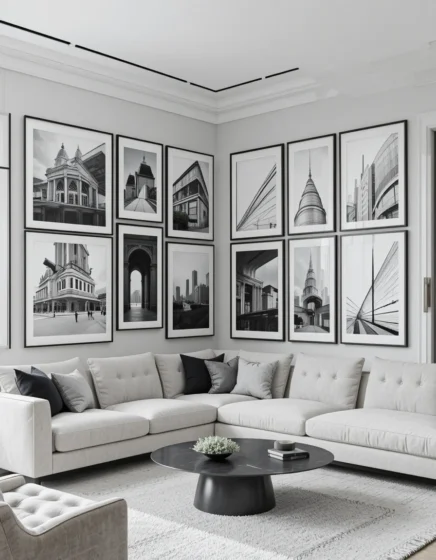
I love using this technique when a living room needs a modern, polished anchor. You mount matching black frames across both walls, keeping the spacing precisely two inches apart as the art turns the central crease. The secret here is selecting high-contrast black-and-white architectural photography or abstract line art with generous white matting. This precise continuity tricks the eye into viewing the two separate surfaces as a single, sweeping canvas.
2. Cascading Floating Ledge Corner Display
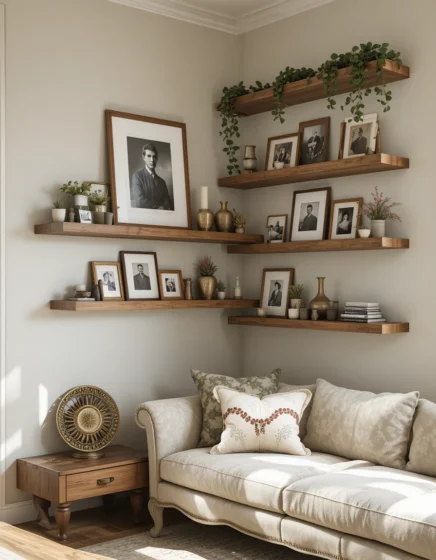
When clients want the flexibility to rotate artwork without making fresh holes every season, I install floating wood ledges that join right at the corner junction. Stagger the shelf lengths slightly—a longer shelf on the left wall and a shorter one on the right—to create an organic, architectural rhythm. Layer large framed art prints at the back, resting smaller framed photos, vintage brass objects, or trailing ivy in front for rich, touchable texture.
3. Asymmetrical Dual-Wall Salon Hang
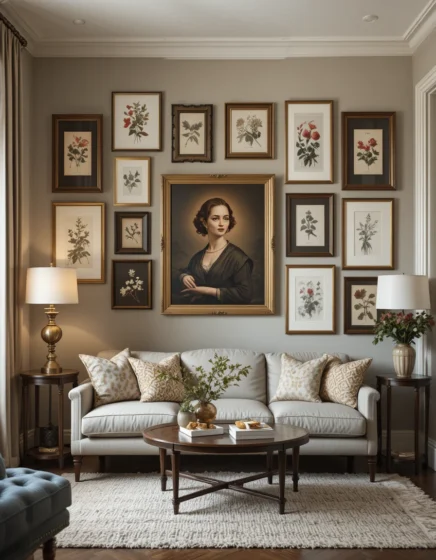
For creative, lived-in homes, an asymmetric salon hang breaks the rigid rules of traditional framing by mixing vintage oil paintings, line drawings, and modern prints. I start by placing the largest visual anchor piece slightly off-center on one wall, then build outward across the corner using smaller accent frames. Vary the frame materials—combining warm walnut, gilded gold, and matte black—to give the impression of a collection gathered naturally over time.
4. Floor-to-Ceiling Vertical Spine Display
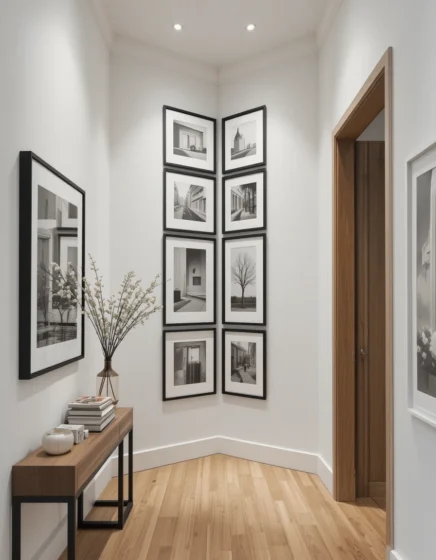
Low ceilings can make a room feel boxy, but a tight vertical column of art right in the corner instantly pulls the line of sight upward. Stack six to eight uniform square frames top-to-bottom along the vertical crease, keeping the outer edges perfectly aligned on both intersecting sides. This technique works exceptionally well in tight entryways or narrow hallway corners where horizontal space is at a premium.
5. Architectural Vintage Mirror Collage
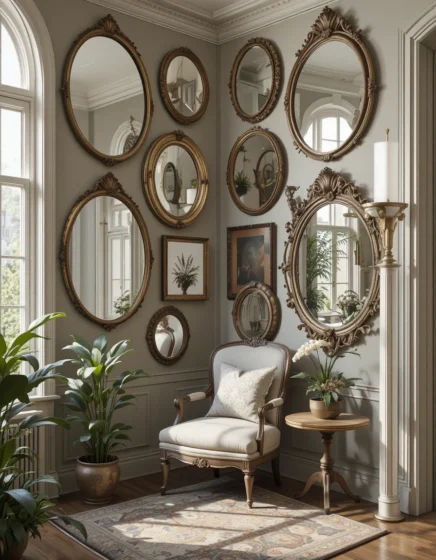
Small or dimly lit corners benefit tremendously from light reflection, which is why I often source mixed antique mirrors for narrow nooks. Gather an assortment of oval, arched, and rectangular mirrors with ornate brass or weathered timber frames, positioning them so they catch light from nearby windows. The intersecting angles reflect different parts of the room, creating an intriguing, kaleidoscope-like spatial illusion that makes tiny rooms feel noticeably larger.
6. Mixed Media Sculptural and Art Fusion
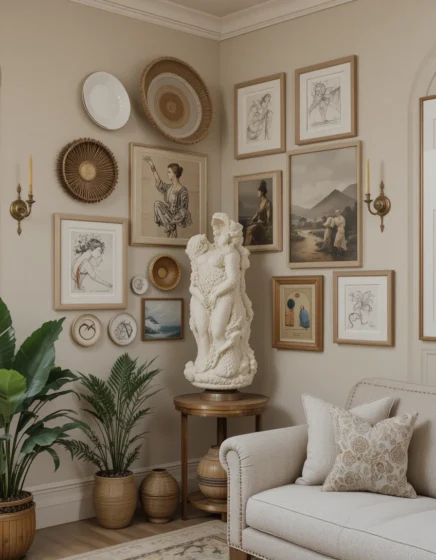
A corner gallery does not need to be limited to flat canvas prints and glass frames. I frequently incorporate dimensional wall objects—such as ceramic plates, wrought iron trivets, woven seagrass baskets, or small wall-mounted brass sconces—alongside traditional framed artwork. Hanging a sculptural piece right in the tight center crease breaks up hard wall planes and introduces an inviting, tactile energy.
7. The L-Shaped Botanical Herbarium Wall
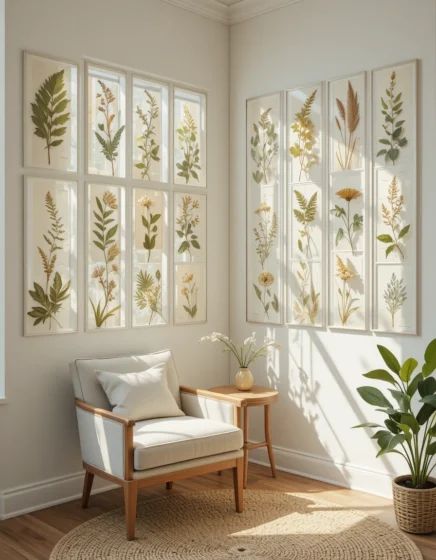
Bring nature indoors by curating a botanical collection that flows naturally around a sunlit corner. Collect pressed fern fronds, dried wildflowers, or vintage botanical book pages, housing them in delicate glass floating frames. The transparent glass lets your wall color show through, making the botanical specimens appear to float gracefully along the corner junction.
8. Structural Ledge and Hanging Frame Hybrid
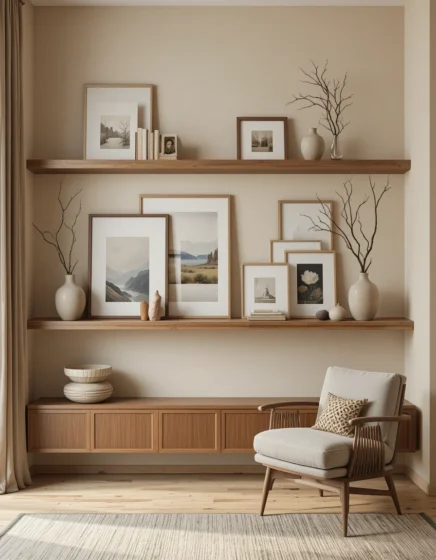
Combining fixed structural ledges with traditionally hung frames creates a sophisticated, multi-layered visual experience. Mount a single long hardwood picture ledge at waist height across the corner, resting heavier framed prints on top while hanging smaller accent frames directly above and below it. This dual approach grounds the bottom half of your display while letting the top collection soar toward the ceiling.
9. Typographic and Grid Photography Combination
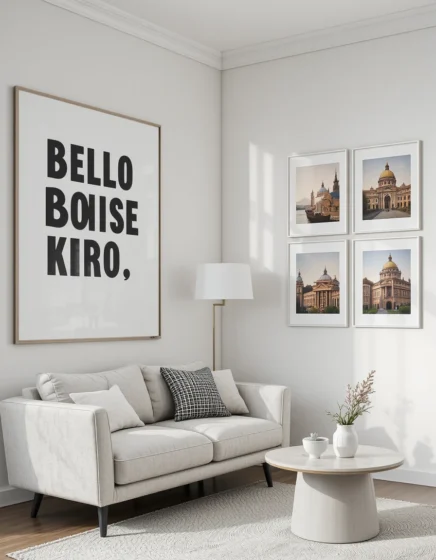
Pair bold graphic typography prints on one side of the corner with a clean four-frame grid of personal travel photography on the adjacent wall. The bold lettering acts as a contemporary graphic anchor, while the grid side offers an intimate personal story. Keeping the frame colors uniform—such as all crisp white or raw birch wood—ties the two distinct artistic themes together smoothly.
10. Wraparound Dip-Dye Color Block Gallery
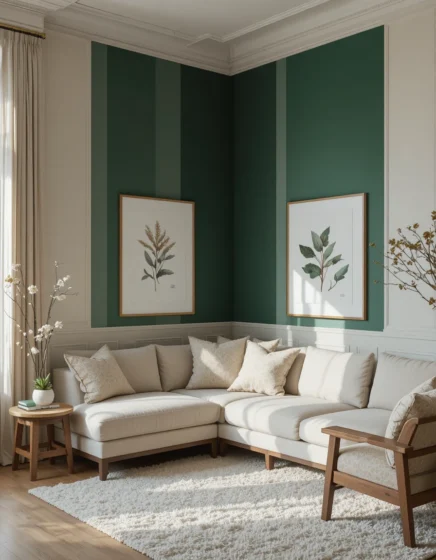
Before hanging a single frame, paint a wide vertical band of rich accent paint—like deep forest green, navy, or terracotta—directly into the corner, extending two feet onto each wall. Mount thin light-oak frames over this painted zone, letting some frames cross the painted edge into the main wall color. This intentional color-blocking technique frames the gallery itself, transforming a plain drywall angle into an intentional architectural zone.
11. Cozy Reading Nook L-Shaped Gallery
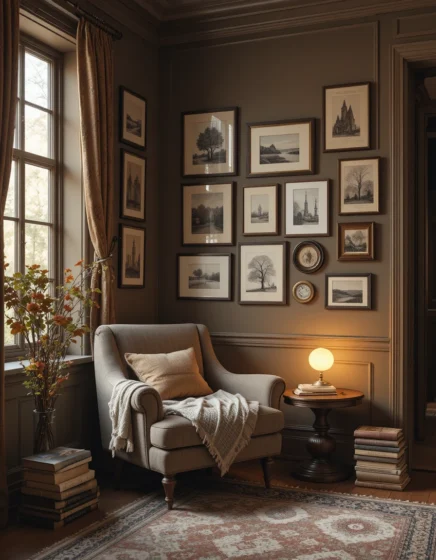
Transform an unused bedroom or living room corner into an inviting literary retreat by placing a deep armchair below a low-slung, L-shaped gallery. Arrange cozy, warm-toned landscape prints, charcoal sketches, and personal poetry slips in a downward curve that cradles the seating area below. Keeping the lowest frames closer to eye level when seated creates an intimate, cocoon-like atmosphere perfect for unwinding.
12. Minimalist Single-Line Shadowbox Grid
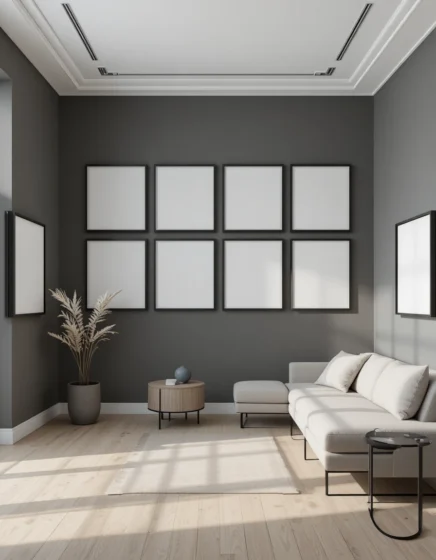
If your interior leanings favor clean, minimalist aesthetics, use identical square shadowbox frames set with high-contrast, minimalist matting. Line up three shadowboxes horizontally on the left wall and extend three onto the right wall at exact eye level. The deep profile of shadowbox frames casts subtle, shifting shadows into the corner throughout the day, providing quiet dynamic interest without cluttering the space.
13. Heritage Family Portrait Timeline
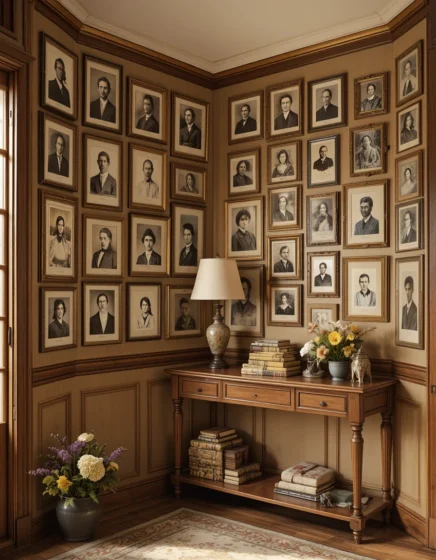
Rather than scattering family photos across multiple rooms, dedicate a quiet corner to a structured chronological gallery. Position vintage black-and-white ancestral portraits on one wall, letting the collection transition into modern color family photographs as it turns the corner. Use matching mats with varying vintage frames to honor your personal history while maintaining design continuity across the space.
14. High-Contrast Gallery with Integrated Accent Sconces
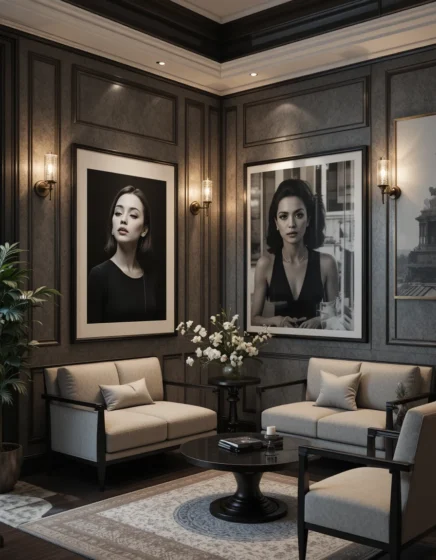
Lighting is often overlooked in corner installations, yet it is essential for bringing depth to dark nooks. Mount a pair of hardwired or battery-operated brass wall sconces directly above your main framed artwork on both sides of the corner angle. The warm downlight washes over the framed glass and texture, turning your simple photo arrangement into an gallery-worthy evening showcase.
15. The Wrapped Canvas Corner Panorama
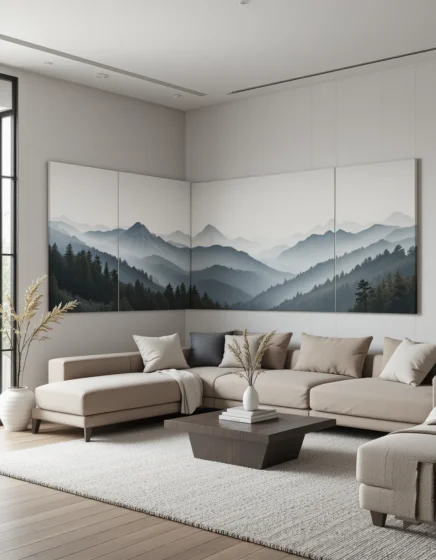
Commission or print a single large-scale landscape or abstract painting split across two continuous gallery-wrapped canvases. Mount the left half of the image on the left wall and the right half on the right wall, meeting tightly in the center fold. The visual continuation of the horizon line turning the corner creates an immersive, three-dimensional window effect that opens up the entire room.
16. Eclectic Basket and Tapestry Textile Wall
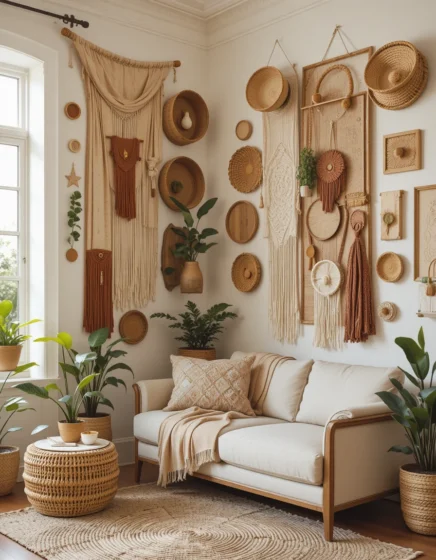
For modern bohemian or rustic homes, swap heavy glass frames for lightweight woven textiles, hand-dyed wall hangings, and shallow wicker trays. Arrange the pieces so they overlap slightly near the corner, softening the hard junction with rich natural fibers. The varied weaves absorb sound, making this an excellent, budget-friendly decor fix for noisy or echo-prone spaces.
17. The Arch and Frame Architectural Illusion
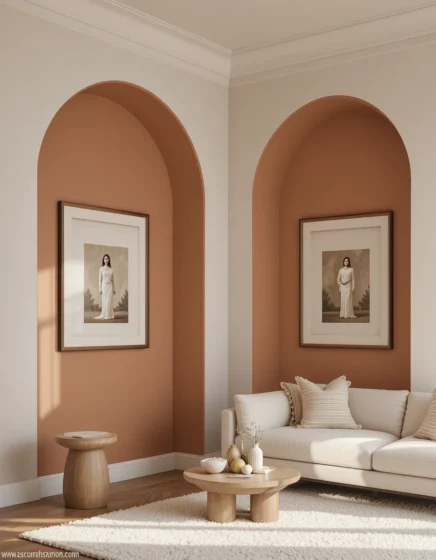
Use paint to create soft, painted arch silhouettes on both walls meeting in the corner, then hang framed artwork centered inside each arch. The soft curve of the painted arches contrasts beautifully with the sharp 90-degree corner fold, softening the room’s geometry. This approach provides an immediate elevated design look using simple sample paint tins and basic tape.
18. Minimalist Pegboard and Modular Frame System
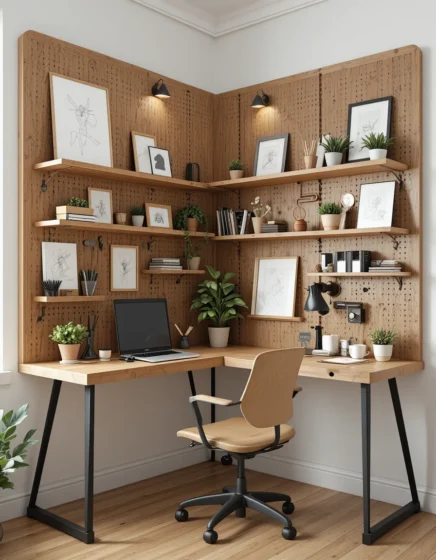
For a modern studio, home office, or craft space, install a custom L-shaped wooden pegboard system tightly fitted into the corner. Hang small framed sketches, mini canvases, wooden pegs, and small plant baskets using adjustable metal hooks. This allows you to redesign your corner layout whenever inspiration strikes, keeping your creative workspace dynamic and organized.
Spatial Psychology & Optical Tricks
Designing a successful gallery display requires more than just picking pretty art; it relies on spatial mechanics and visual balance. When two walls meet at 90 degrees, the human eye naturally perceives a visual break or dark drop-off point.
By running artwork continuously across that seam, you visually erase the hard boundary. This creates a perceived curve rather than a sharp stopping point, which tricks the brain into expanding the room’s perimeter.
Furthermore, color psychology suggests that visually grounding room corners reduces spatial anxiety. An empty, shadowy corner feels neglected, whereas an intentional art display turns a dead zone into an inviting anchor point.
Frequently Asked Questions
How far apart should frames be placed around a corner?
Maintain a consistent gap of 2 to 3 inches between frames on the flat wall surfaces. As you turn the actual 90-degree corner crease, increase that gap slightly to 3 or 3.5 inches so the frame edges do not visually collide when viewed from an angle.
What is the ideal hanging height for a corner gallery?
The focal center of your overall gallery should sit roughly 57 to 60 inches from the floor, which represents standard eye level. If you are placing a corner gallery above seating, keep the bottom frame edges at least 8 to 12 inches above the top of the furniture backrest.
Should I use matching frames on both corner walls?
Matching frames create a clean, modern, architectural look that unifies the two walls effortlessly. However, mixing frame materials works equally well if you maintain a consistent thread, such as keeping all mats white or maintaining similar art styles throughout the collection.
Final Thoughts
A neglected corner is not a design flaw; it is an incredible blank canvas waiting for creative structure. Implementing these Corner Wall Gallery Ideas allows you to unlock hidden spatial potential, bring personal character into overlooked nooks, and smooth out hard architectural lines across your home
. Remember that successful styling takes experimentation—test your arrangements using paper templates first, trust your creative instincts, and enjoy watching your empty walls come to life.
